Understanding the Mohs Hardness Scale and Gemstone Hardness
The Mohs hardness scale is a qualitative ordinal scale from 1 (softest) to 10 (hardest) that ranks minerals by scratch resistance. It was devised in 1812 by German geologist Friedrich Mohs. Mohs selected ten reference minerals – talc (1) through diamond (10) – and showed that a harder mineral will scratch any softer one. For example, diamond (10) can scratch corundum (9) and all lower-ranked minerals, while talc (1) can be scratched by everything else. This simple, enduring system remains widely used in gemology and geology to gauge a material’s resistance to abrasion.

Despite its usefulness, the Mohs scale has limitations: it measures only scratch hardness, not toughness or durability. Hardness does not equate to impact resistance. For instance, diamond is extremely hard but can cleave or chip under sharp impact, whereas a softer mineral might flex without breaking. Also, the scale is not linear – the gap in actual hardness between successive numbers varies greatly. Diamond (10) is far more than just one “unit” harder than corundum (9); in absolute terms diamond is about four times as hard as corundum. (The chart below illustrates this: on a log scale, diamond’s hardness jumps dramatically above the rest.)
Graph illustrating that Mohs values are ordinal. Corundum (9) is about twice as hard as topaz (8), while diamond (10) is roughly four times as hard as corundum.
Mohs Scale and Scratch Testing
The Mohs test is performed by scratching: a reference mineral or pick is dragged across the unknown material’s surface. If it leaves a visible non‐elastic scratch, the reference is harder than the sample. For example, if a hardness-5 apatite pick scratches the sample but a hardness-6 orthoclase pick does not, the sample’s Mohs hardness is between 5 and 6. The protocol is straightforward: “If Specimen A can scratch Specimen B, then Specimen A is harder than Specimen B”. Most Mohs kits contain labeled picks or crystals for ranks 2–9 (diamond 10 is often omitted, since real diamond specimens are costly and brittle).
A Mohs hardness test kit: numbered hardness picks (2–9) and plates of known hardness. To test a gem, one drags the hardest pick the gem can resist. The sample’s Mohs rating lies between the pick numbers that do and do not scratch it.

Doing the scratch test safely involves holding the unknown firmly and drawing the point of the reference along its surface. Geologists routinely use this method to identify minerals in the field or lab. In practice, one starts with a mid-range pick: if it scratches, try a harder one; if not, try a softer one. By bracketing the results, one quickly estimates the mineral’s Mohs value. (This destructive test is quick and easy but cannot be used on finished gems without caution!)
The Ten Reference Minerals (1–10)
Friedrich Mohs chose ten minerals with distinct hardness:
- Talc (1) – very soft, greasy feel.
- Gypsum (2) – can be scratched with a fingernail.
- Calcite (3) – reacts with dilute acid.
- Fluorite (4) – common colorful crystal.
- Apatite (5) – often green/blue; used as gem (apatite).
- Orthoclase Feldspar (6) – e.g. Moonstone, Amazonite; primary component of granite.
- Quartz (7) – e.g. Amethyst, Citrine, Rose Quartz, Agate; very common.
- Topaz (8) – common jewelry gem (brown, blue, yellow).
- Corundum (9) – Ruby and Sapphire (red or blue corundum).
- Diamond (10) – hardest known natural material (pure carbon crystal).
Each reference mineral scratches all those below it, but not the ones above. For example, topaz (8) will scratch quartz (7) and below, but is itself scratched by corundum (9) and diamond (10). Mohs’ choice conveniently matches many gem species: corundum (rubies/sapphires) is ranked 9, quartz (amethyst, citrine, etc.) is 7, etc.
Famous Gemstones and Their Mohs Hardness
Below are some notable gemstones with their Mohs ratings and key traits:
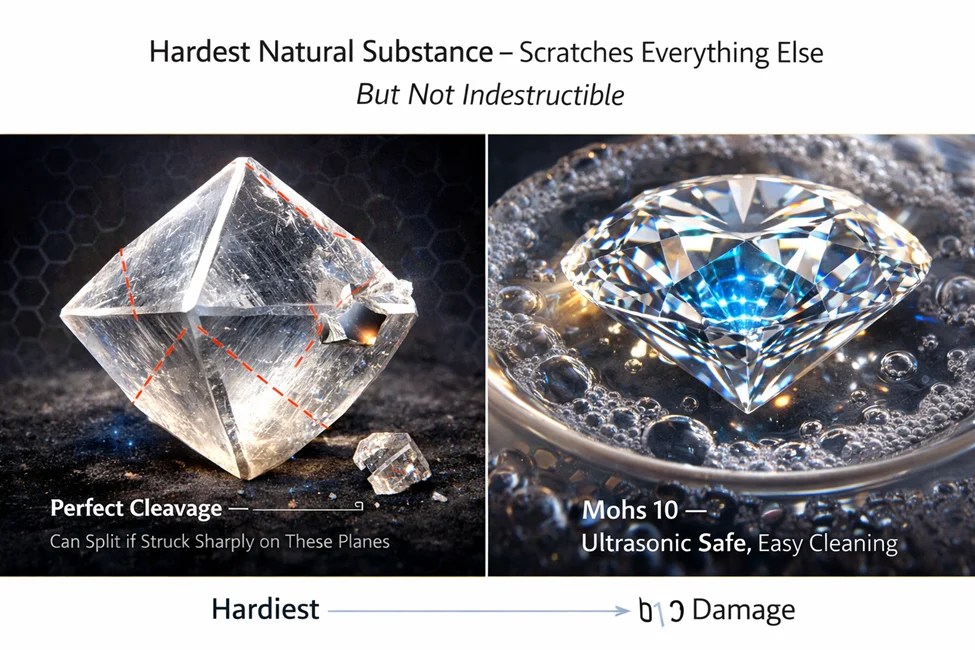
- Diamond (10) – The hardest natural substance. Composed of carbon (C), it stands alone at 10. Diamond will scratch all other minerals on the Mohs scale, including corundum (9). Its perfect octahedral cleavage means it can cleave if struck sharply on certain planes, so even diamonds must be handled with care. (Cleaning is easy: warm soapy water or ultrasonic baths pose no problem for diamond.)

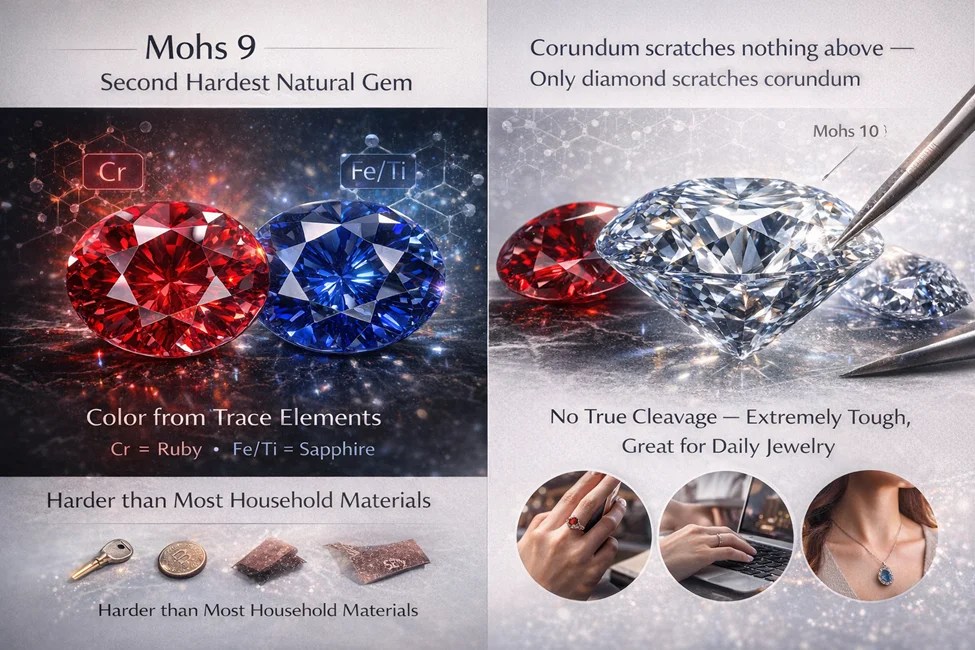
- Ruby and Sapphire (Corundum, 9) – Both are forms of corundum (Al₂O₃) and rate a 9 on Mohs. Only diamond is harder. Rubies (red) and sapphires (blue and other colors) are extremely durable and suitable for everyday jewelry (harder than most household materials). They have no true cleavage (only parting), so they are tough against breakage. Their color is due to trace elements (Cr for ruby, Fe/Ti for sapphire), but these do not affect hardness. (The IGS notes rubies are “hardness 9” and second only to diamond.)

- Topaz (8) – A common gem, topaz is 8 on Mohs. It occurs in many colors (yellow, blue, pink, etc.). Topaz has perfect basal cleavage – it can split along one plane – so it must be protected from sharp blows (avoid rough abrasion). It is relatively stable; safe to clean with warm soapy water, but should not be exposed to sudden heat or steam (to avoid cleavage-related damage). (Despite that, its 8 hardness makes topaz moderately scratch-resistant.)

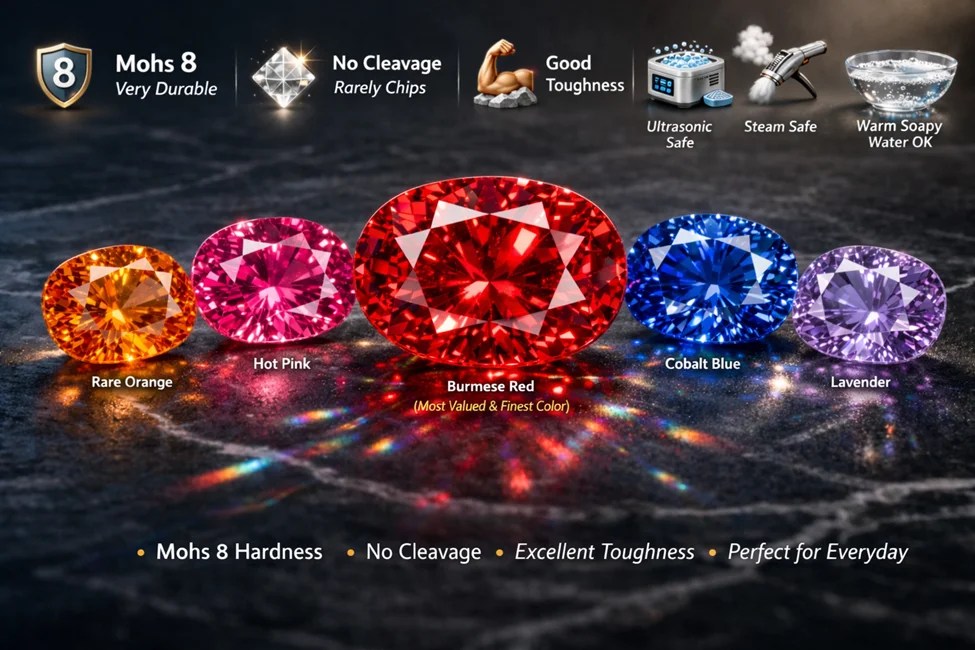
- Spinel (8) – Many spinel gems (red, pink, blue, etc.) also have hardness 8. Spinel is a vitreous gem known for good durability. The GIA notes “Spinel ranks 8 on the Mohs hardness scale” and has good toughness, meaning it is one of the most durable color gemstones. It has no cleavage, so it rarely chips. Cleaning is straightforward: ultrasonic and steam cleaning are generally safe, but as with all faceted stones, warm soapy water is simplest.

- Emerald and Aquamarine (Beryl, ~7.5–8) – Emerald is green beryl, aquamarine is blue beryl; both are in the beryl mineral family. Precious beryl crystals have Mohs hardness around 7.5–8. Emeralds tend to have surface-reaching fissures (inclusions) and are often oiled to improve clarity, but their inherent hardness is about the same as aquamarine (very hard quartz). With hardness near 8, emeralds and aquamarines are hard enough for most jewelry, but their inclusions mean they must be treated gently. (Emerald care often warns against steam or ultrasonic if heavily included, favoring gentle soap-and-water.)

- Quartz (7) – This huge family (SiO₂) is hardness 7. Examples include Amethyst, Citrine, Rose Quartz, Smoky Quartz, Agate, and Crystal (rock crystal). Quartz is tougher and more abundant than orthoclase (6) and much harder than feldspar, so it scratches glass and steel. Its hardness of 7 makes quartz gems durable for all types of jewelry. Clean quartz with soap and water; they handle household wear with ease.

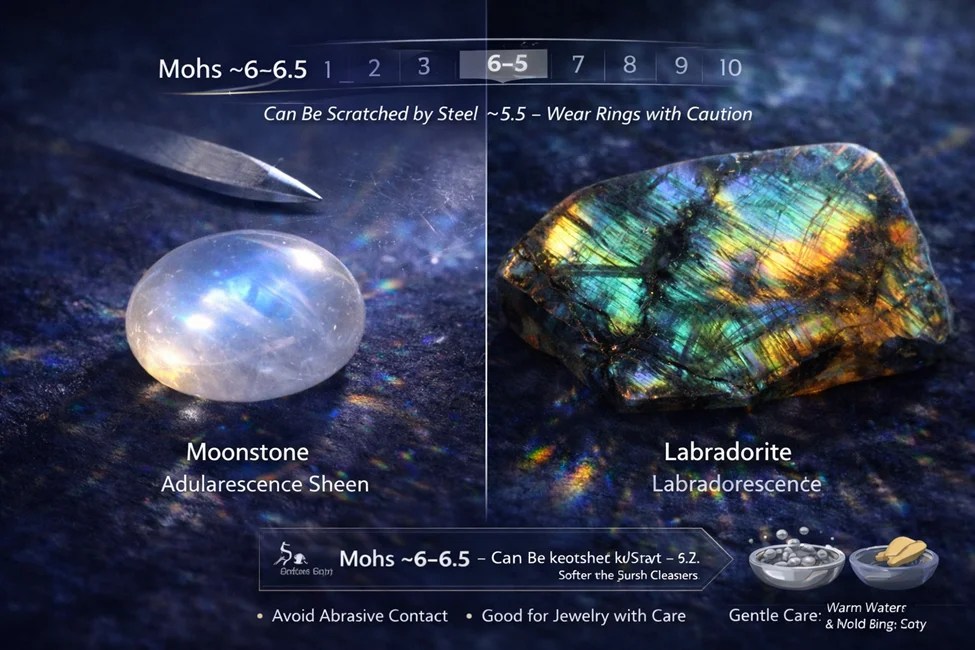
- Moonstone and Labradorite (Orthoclase/Plagioclase Feldspar, ~6–6.5) – Feldspar minerals range about 6–6.5 on Mohs. Moonstone (orthoclase) is rated ~6.0–6.5. Labradorite (plagioclase) is similar. These gems display adularescence or labradorescence but are noticeably softer than quartz. They can be scratched by steel (a knife has hardness ~5.5) if not careful. Wear moonstone rings with some caution – avoid abrasive contact. Cleaning should be gentle (warm water and mild soap).

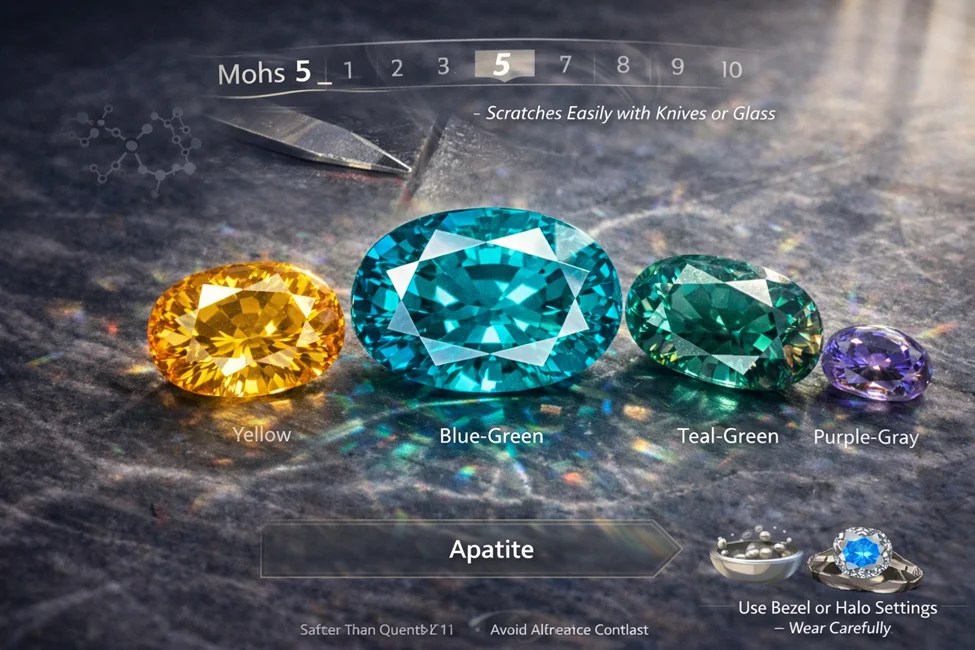
- Apatite (5) – When transparent and cut as a gem, apatite shows vivid blue-green to yellow colors. Its Mohs hardness is 5. Apatite scratches easily by knives or glass. Because it is relatively soft, apatite gems must be set with protection (bezel or halo) and worn carefully to prevent scratching. Clean apatite simply with warm soapy water.

- Opal (~5–6.5) – Precious opal (hydrated silica) varies in hardness, roughly 5.0–6.5. Its notable play-of-color makes it prized, but this opalescence comes with fragility. Opal has poor cleavage and low toughness, so it chips or scratches easily. GIA advises that “opal requires care … to not scratch or break the stone.” The only safe cleaning is mild soap and warm water; avoid chemicals, abrasion, and sudden temperature changes.

- Pearl and Amber (~2.5–4) – (Not shown on Mohs’ original scale, but for reference.) Organic gems like pearls (~2.5) and amber (~2–2.5) are very soft and require utmost care (always clean with soft cloth and avoid chemicals). These are at the extreme soft end and are easily scratched by harder gemstones or contact.

Each gemstone’s Mohs rating guides its use: harder gems (8–10) like sapphire, diamond, topaz are excellent for rings and daily wear, while softer gems (<6) need protective settings or occasional wear only.
Scratch Testing and Practical Hardness
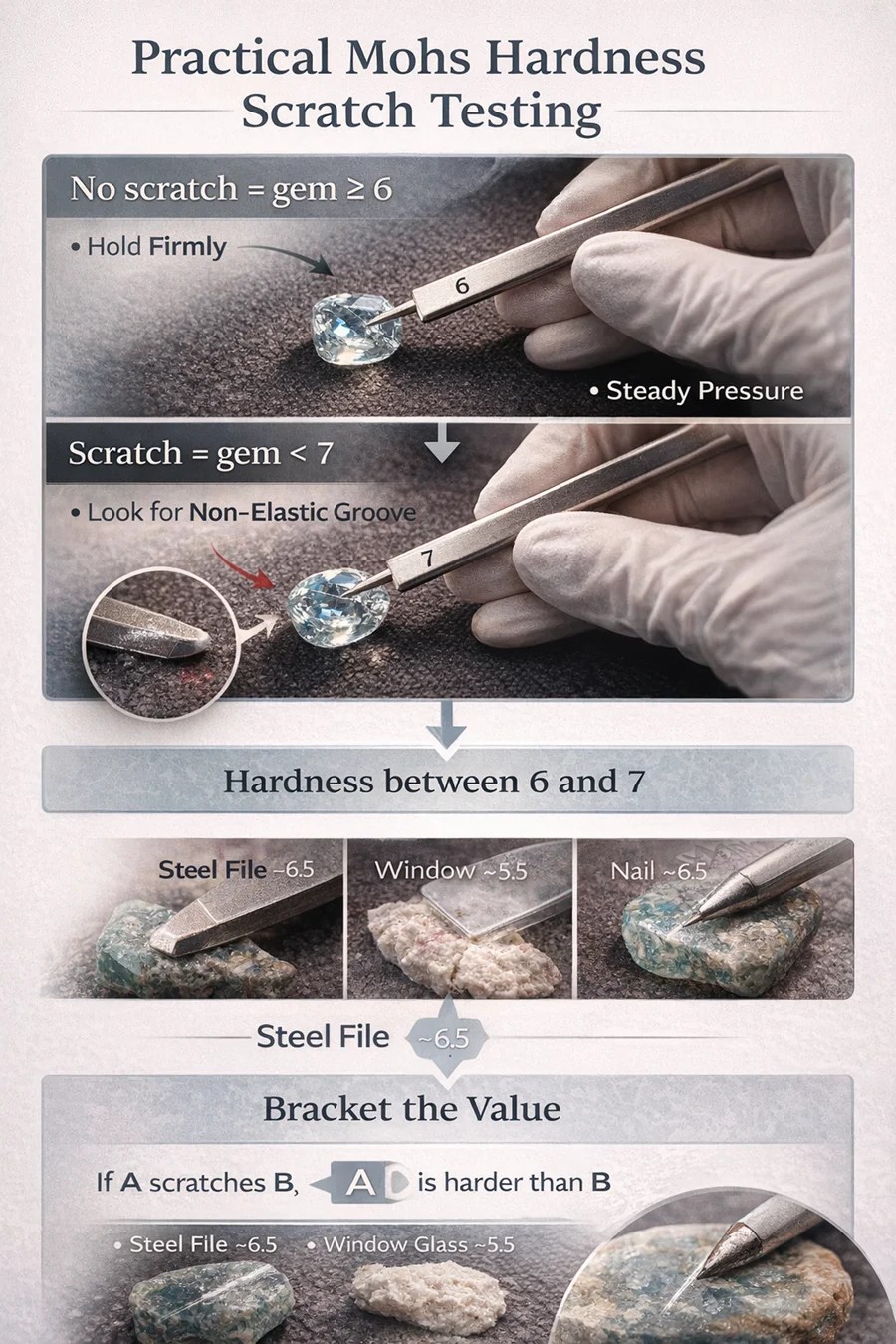
In practical gemology, Mohs hardness is tested using kits or common items. A standard kit has minerals or picks labeled 2–9 that act as hardness points. For example, a jewelry bench might use steel files (∼6.5), glass plates (∼5.5) or even common objects (nails ∼6.5, window glass ∼5.5) as rough hardness testers. If a known steel pick (hardness ~7) scratches a gemstone, we know the gem is <7; if not, it is ≥7. These comparisons help identify unknown stones on the spot.
Hardness testing steps: Hold the test stone firmly and press the reference point against a clean spot on its surface. Drag the harder object across the surface with steady pressure. A true scratch (a non-removable groove) means the tool is harder. If no scratch appears, the tool is softer or equal. By applying the tool that just barely scratches (and one notch above that doesn’t), you bracket the Mohs value. As geology.com explains, “If Specimen A can scratch Specimen B, then Specimen A is harder than Specimen B” (and vice versa).

Mohs Hardness Chart and Comparisons
Because the Mohs scale is relative, professionals often consult hardness charts that list many materials. For instance, a Mohs kit graphic might show that a steel file is about 6.5, glass ~5.5, a borosilicate plate ~7.0, etc.. Such charts (like the one above) illustrate how everyday items relate: a kitchen knife (~5.5) can scratch calcite (3) and gypsum (2) easily, but not quartz (7) or corundum (9). Gem charts often list dozens of minerals (see the IGS “Select Gems by Hardness” table) for quick reference. In practice, gem cutters and collectors use these to estimate or confirm stone identity by hardness.
Gemstone Care by Hardness
Hardness greatly influences how gems are treated and worn. In general:
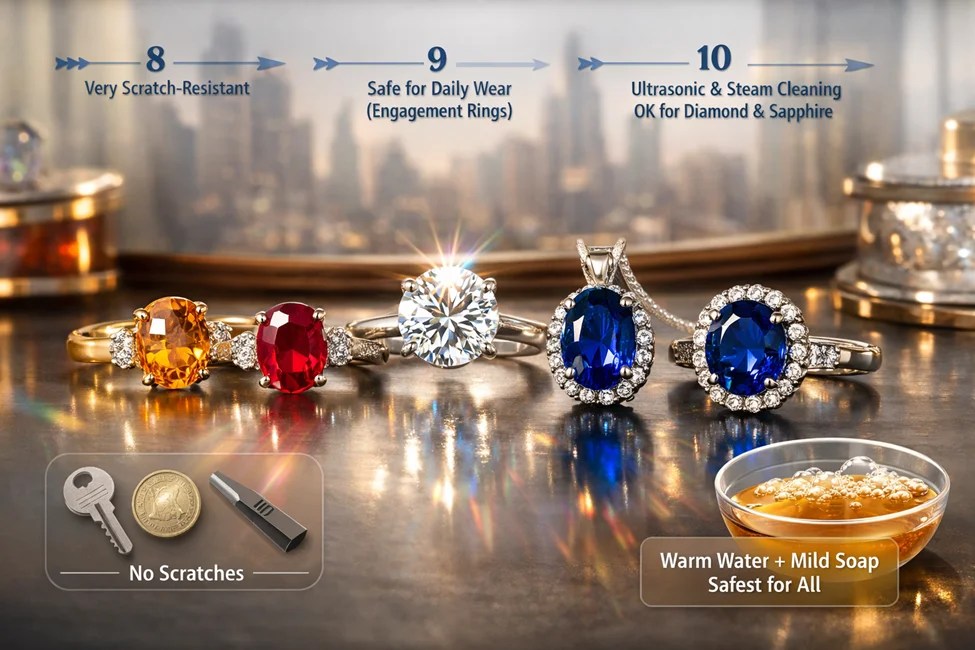
- Hard stones (Mohs 8–10): Diamond (10), corundum (9), topaz and spinel (8) are very scratch-resistant. They can be safely worn daily (e.g. engagement rings). Diamond and sapphire can endure ultrasonic or steam cleaning. Cleaning tip: Use warm water with mild soap; ultrasonic is fine for these (though beware diamond chips if inclusions are present, and avoid high heat for some stones like topaz).

- Intermediate stones (Mohs 6–7): Quartz (7), beryl (7.5–8), feldspars (6–6.5) are reasonably durable. They resist scratches better than most metals, but can still be abraded by grit or other gems. Topaz: protect from knocks and extreme heat; use only soapy water. Spinel: extremely durable; GIA notes ultrasonic is “usually safe”. Quartz: very forgiving – it won’t be scratched by household wear; clean with water.

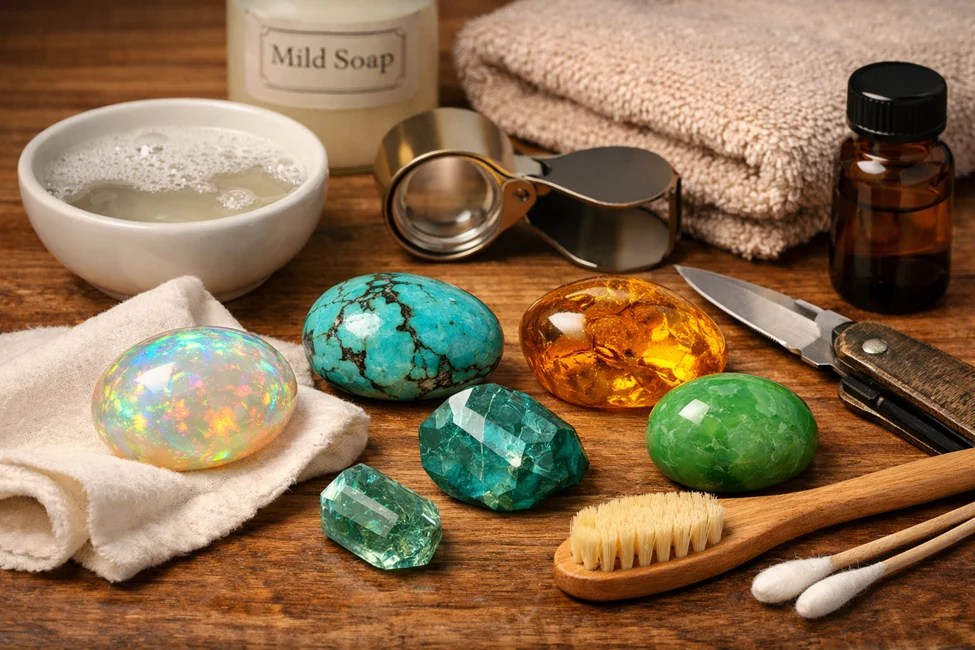
- Soft stones (Mohs 1–5): Opal (5–6.5), turquoise (5–6), jadeite (6–7), amber (2–3), etc., need extra care. They scratch easily on contact with metal or harder stones. For example, opal’s hardness is only around 5–6, so it should be protected. GIA advises cleaning opal only with warm soapy water (no steam/ultrasonic). Apatite (5): can be scratched by a knife; set in bezel or wax, clean gently. Turquoise (5–6): avoid chemicals (it is porous) – warm water and soft brush only.

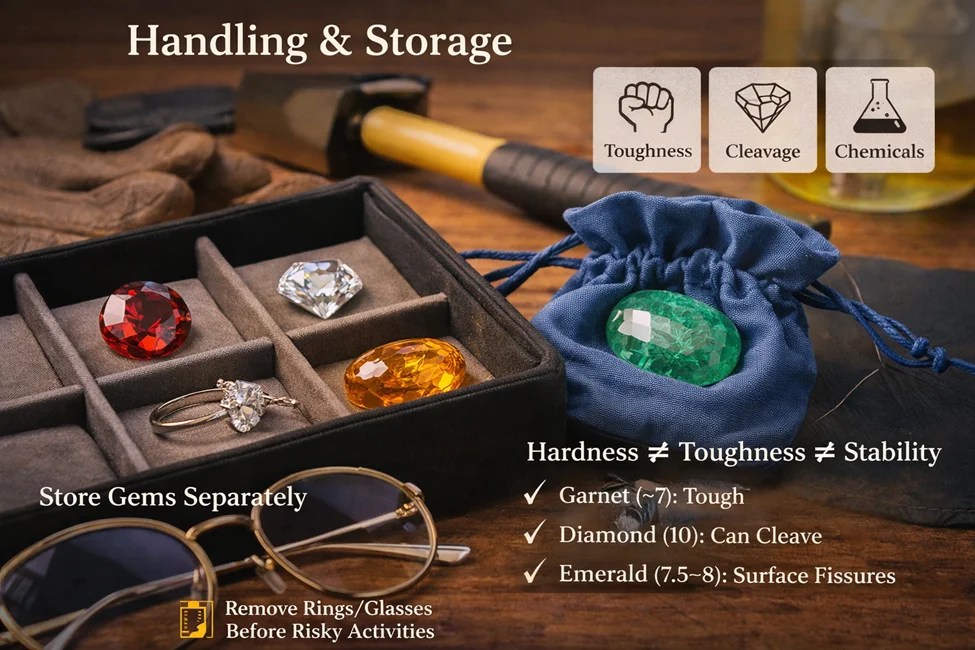
- Handling and storage: Always store gems separately (e.g. padded boxes or soft pouches) so harder stones don’t scratch softer ones. Remove rings/glasses before activities that could expose them to grit or blows. Remember that Mohs hardness is only one durability factor; toughness (resistance to chipping) and stability (reaction to chemicals/light) are also important. For example, garnet (Hardness ~7) is tough, but diamond (10) can cleave; emerald (7.5–8) is fairly hard but often has surface fissures.

Care tips (examples):
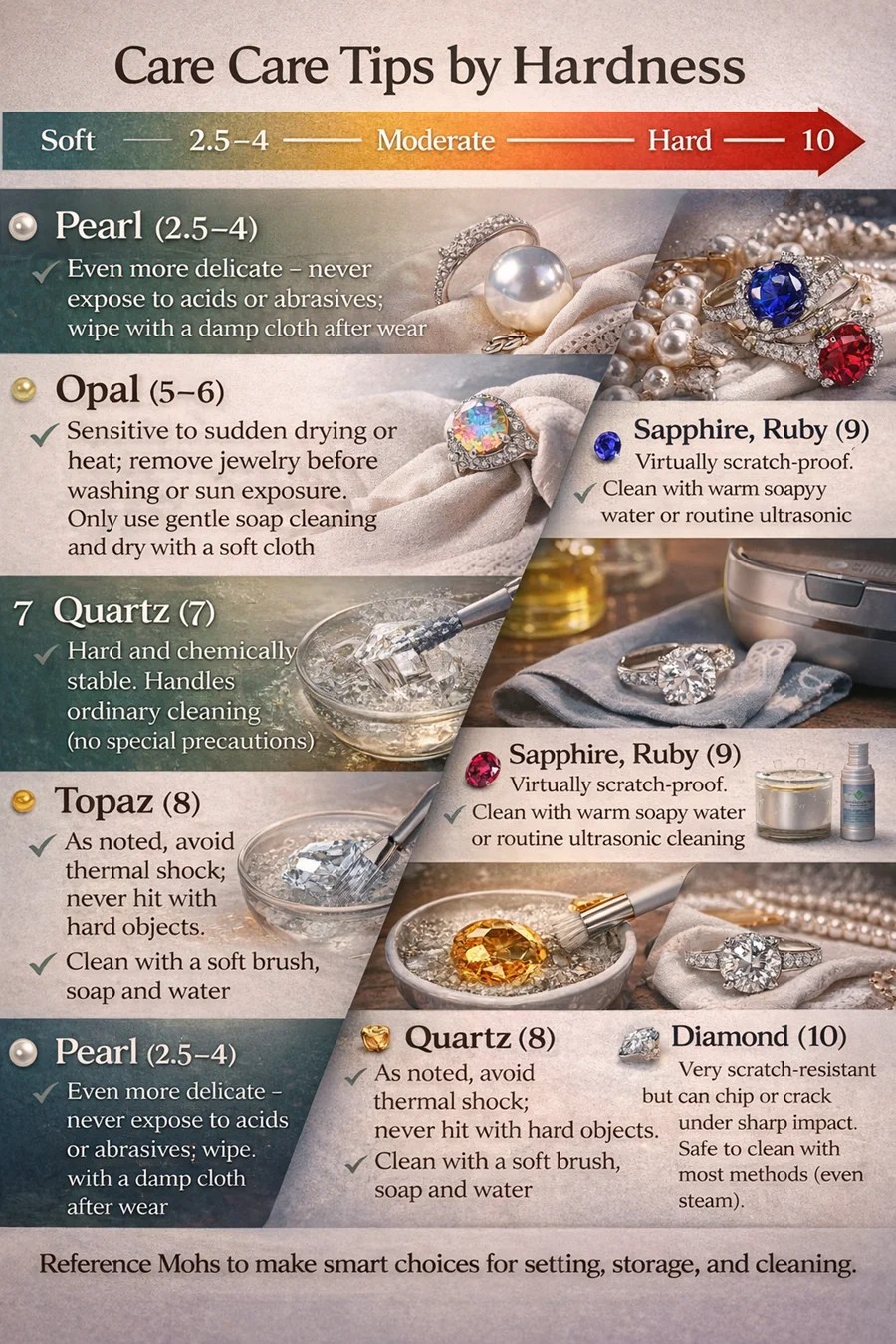
- Sapphire, Ruby (9): Virtually scratch-proof. Clean with warm soapy water or routine ultrasonic cleaning.
- Diamond (10): Very scratch-resistant but can chip or crack under sharp impact. Safe to clean with most methods (even steam).
- Topaz (8): As noted, avoid thermal shock; never hit with hard objects. Clean with a soft brush, soap and water.
- Quartz (7): Hard and chemically stable. Handles ordinary cleaning (no special precautions).
- Opal (5–6): Sensitive to sudden drying or heat; remove jewelry before washing or sun exposure. Only use gentle soap cleaning and dry with a soft cloth.
- Pearl (2.5–4): Even more delicate – never expose to acids or abrasives; wipe with a damp cloth after wear.

By referencing the Mohs scale, gem owners and jewelers can make smart choices about setting (e.g. prongs vs. bezel), storage, and cleaning, ensuring that each gemstone is treated in accordance with its hardness.








 13
Oct
 13
Oct
 02
Oct
 23
Sep