No products in the cart.
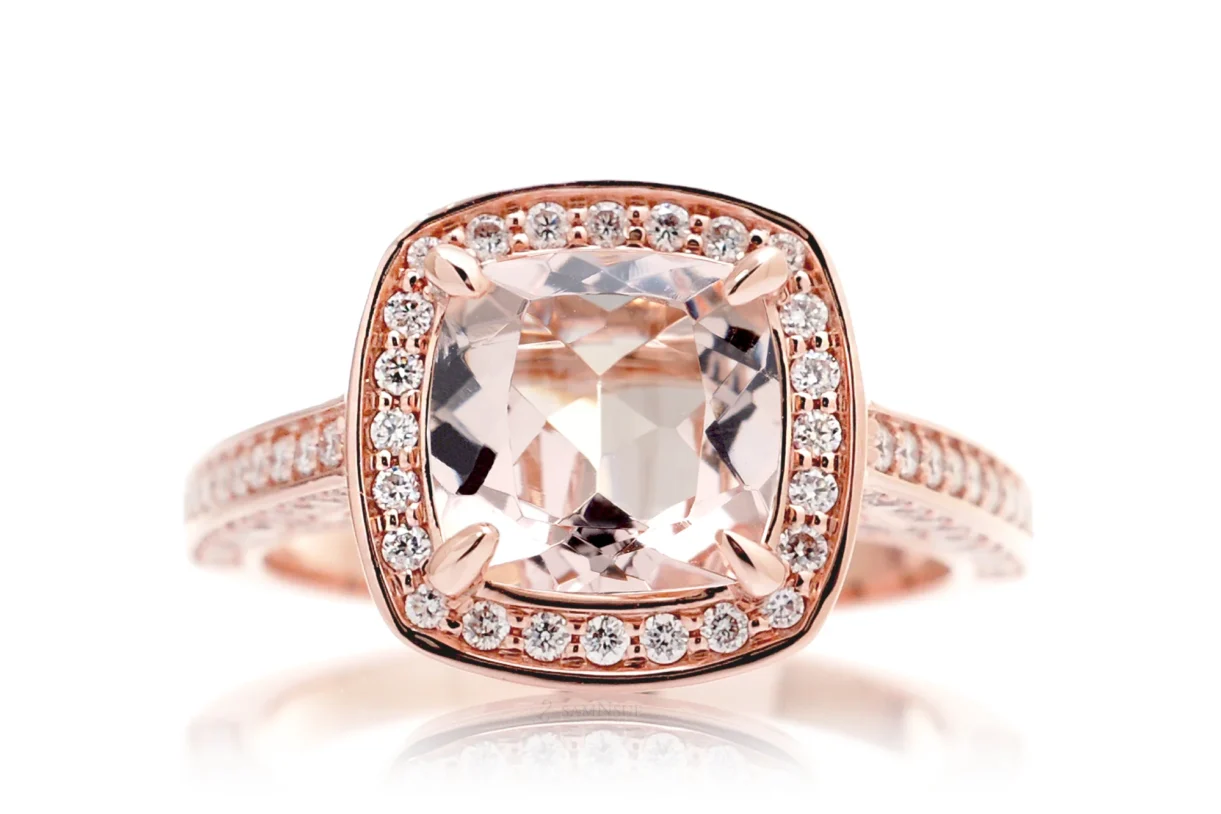
Among the distinguished members of the beryl gem family, including emerald and aquamarine – morganite stands out for its romantic blush hues and refined elegance. Though not as commercially celebrated as its green and blue counterparts, morganite has steadily gained admiration among gem connoisseurs for its delicate pleochroism, impressive clarity, and excellent durability.
First identified in 1911 by gemologist George F. Kunz of Tiffany & Co., morganite was named in honor of financier and gem enthusiast J. P. Morgan. Since then, it has become a prized pastel gemstone in fine jewelry, bridal designs, and collector circles.
Following the discovery of a new locality for rose beryl in Madagascar in 1910, George Frederick Kunz proposed the name morganite at a meeting of the New York Academy of Sciences on 5 December 1910. The name honored J. P. Morgan — the famous American banker, financier, and avid gemstone collector — in recognition of his generous support of the arts and sciences, as well as his significant donations of gemstones to the American Museum of Natural History in New York and to the Museum of Natural History in Paris.
Morgan was one of the most important gem collectors of the early 20th century, and his renowned collection was partly assembled by Tiffany & Co. under the guidance of their chief gemologist, Kunz. The name morganite was officially adopted in December 1910.
Among the gem’s notable scientific properties, Kunz observed that morganite exhibits an intense red fluorescence when exposed to X-rays, yet shows no phosphorescence once the X-ray source is removed — an interesting diagnostic characteristic within the beryl group.
Morganite is an allochromatic variety of beryl, colored primarily by trace amounts of manganese. Its color palette ranges from:
Being pleochroic, morganite can show a bluish-pink tone from one direction and a warmer pink or orange-pink from another. Skilled lapidaries orient the rough to emphasize the preferred pure pink hues, as market demand strongly favors vibrant, saturated pink stones over bluish modifiers.

The highest per-carat values are achieved by stones exhibiting:
Collectors and dealers often agree that deep pink stones originating from Madagascar set the historical benchmark for fine morganite color.
Most morganite on the market undergoes routine heat treatment. This process:
Gemological laboratories such as Gemological Institute of America (GIA) frequently note that heat treatment in morganite is often undetectable through standard testing methods.
While untreated stones are rarer and sought by purists, the majority of the trade accepts heated morganite as standard practice. Disclosure remains an essential ethical and commercial requirement.
Unlike emerald, large morganite crystals are relatively common. Rough specimens can weigh several kilograms, especially from Brazilian deposits.
However, value is influenced more by color concentration than by sheer size. Because color deepens with depth, larger stones may appear more saturated and thus command higher prices; but stones exceeding 20 carats often see diminished demand due to practicality in jewelry design.
Key pricing factors:
Carat weight plays a secondary, indirect role.
Morganite shares with aquamarine the advantage of typically being eye-clean. High transparency and minimal inclusions are common, even in large stones.
Stones with visible inclusions are:
Fine faceted morganite should display:

Unlike diamonds, morganite does not have rigid proportion standards. This gives cutters creative freedom to experiment with:
Its pastel tones pair beautifully with rose gold settings, enhancing its romantic aesthetic.
Exceptional artistry can dramatically elevate value, especially in collector-grade fantasy cuts.
The original source and historical gold standard. Known for deeply saturated magenta-pink crystals. Largely depleted today.
Currently the leading supplier. Produces large, clean crystals, often in lighter peach-pink hues.
Emerging sources contributing fine pastel material. Each locality shows subtle chemical variations affecting hue intensity and tone.
 Synthetic Morganite: Rare but Present
Lab-grown morganite exists but remains uncommon due to:
Synthetic stones may appeal to buyers seeking highly saturated color at a lower cost, though disclosure is critical.
Although morganite does not have as many headline-grabbing specimens as emerald or ruby, several notable examples have earned recognition:
Discovered in the early 20th century in Maine, USA, this historic morganite specimen helped solidify the gem’s reputation in North America. Maine remains an important early American source of gem-quality beryl.
A richly saturated magenta morganite recovered from Madagascar in the mid-20th century became a benchmark example for collectors. Stones from this locality are still considered the pinnacle of fine color.
One of the most impressive faceted morganites is housed at the Smithsonian National Museum of Natural History in Washington, D.C. Weighing approximately 598 carats, this Brazilian stone demonstrates the exceptional clarity and delicate peach-pink tone typical of large crystals from Brazil. It remains one of the largest faceted morganites on public display.

Its hardness and durability make it suitable for rings, pendants, and heirloom jewelry.
Morganite offers a compelling combination of:
Its understated market position keeps per-carat prices accessible, making it an intelligent acquisition for both new collectors and seasoned gem investors.
 Final Thoughts
Morganite is more than a pastel alternative — it is a gemstone of nuance, artistry, and quiet sophistication. From its manganese-driven blush hues to its exceptional clarity and lapidary versatility, it remains one of the most gemologically fascinating members of the beryl group.
For those who understand its subtleties, morganite represents not just beauty — but opportunity.
25
Feb
 19
Feb
19
Feb
 07
Feb
07
Feb
 07
Feb
07
Feb




Not a member yet? Register now
Are you a member? Login now