

Although many people admire coral reefs for their vibrant colours and abundant marine life, few understand the remarkable biology and geological history behind these living ecosystems.

When we think of gemstones, minerals such as diamonds, rubies, sapphires, and emeralds usually come to mind. However, not every gemstone originates from the Earth’s crust. Some of the most prized gem materials are created by living organisms and are known as Organic Gemstones.
Organic gemstones are naturally formed through biological processes rather than geological ones. Unlike mineral gemstones, they are produced by plants or animals and possess unique physical, chemical, and optical characteristics.
Some of the world’s most recognised organic gem materials include:
Among these, Coral has remained one of the most significant materials in jewellery for thousands of years, admired for its rich colours, smooth texture, cultural importance, and natural beauty.
For every gemology student, understanding coral is essential—not only because it is widely used in jewellery but also because it represents one of nature’s most extraordinary living creations.

Unlike mineral gemstones that crystallise beneath the Earth’s surface, coral originates from tiny marine animals known as coral polyps.
Each coral polyp secretes a hard skeleton made of calcium carbonate. Over thousands of years, millions of these tiny organisms build massive underwater structures known as coral reefs. Certain coral species develop dense skeletal material that can be cut, polished, and fashioned into jewellery.
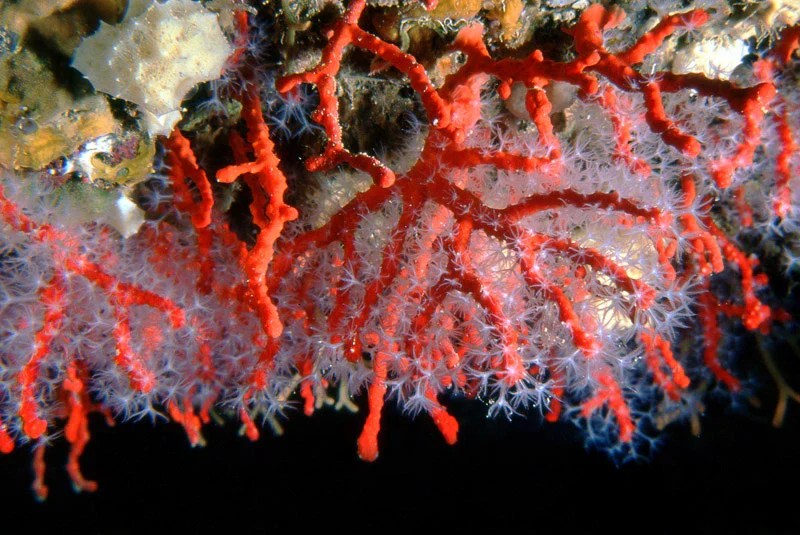
The most valuable jewellery corals belong mainly to the genus Corallium, prized for their beautiful shades of red, pink, salmon, white, and deep oxblood.
Coral therefore represents a unique intersection between marine biology, geology, environmental science, and gemology, making it one of the most fascinating materials studied in the gem and jewellery industry.
Here are ten fascinating facts that showcase why coral reefs deserve our admiration—and our protection.
 1. Coral Reefs Are Built by Tiny Animals
Despite their plant-like appearance, corals are actually marine animals known as coral polyps. Each tiny polyp secretes a hard skeleton made of calcium carbonate. As generations of polyps grow, die, and build upon previous skeletons, enormous reef structures gradually develop over thousands of years.
Only hard corals, commonly called reef-building corals, create these massive limestone formations. Soft corals, such as sea fans and sea whips, add beauty and biodiversity but do not construct reefs.
 2. Coral Reefs Have Existed for Nearly 450 Million Years
Most living coral reefs visible today are between 5,000 and 10,000 years old, having developed after the last Ice Age. However, fossil evidence reveals that coral reefs have existed on Earth for approximately 450 million years, making them far older than the dinosaurs.
This remarkable evolutionary history demonstrates how reefs have adapted to changing oceans for hundreds of millions of years.
Stretching more than 2,300 kilometres along Australia’s Queensland coast, the Great Barrier Reef is the largest coral reef system in the world.
Comprising around 3,000 individual reefs and nearly 900 islands, it covers approximately 344,400 square kilometres. Visible from space, it is one of the largest living structures ever created by biological organisms and is recognized as one of the world’s greatest natural wonders.
 4. There Are More Than 2,500 Coral Species
Scientists have identified over 2,500 species of corals, broadly divided into two categories:
The Coral Triangle in Southeast Asia contains the greatest concentration of coral diversity on Earth, while the Caribbean supports around 60 reef-building coral species.
Corals reproduce both sexually and asexually, allowing reefs to expand and regenerate.
Many species participate in spectacular mass spawning events, releasing millions of eggs and sperm simultaneously into the ocean. These synchronized events are often triggered by moon phases, water temperature, and seasonal changes.
The fertilized eggs develop into microscopic larvae that drift with ocean currents before settling on suitable surfaces to establish new coral colonies.
 6. Corals Are Animals, Not Plants
One of the most common misconceptions is that corals are plants.
In reality, corals belong to the animal kingdom. Unlike plants, they cannot produce their own food through photosynthesis. Instead, they capture microscopic plankton using their tiny tentacles while also living in a remarkable partnership with microscopic algae called zooxanthellae.
These algae provide much of the coral’s energy through photosynthesis, while the coral offers them protection and nutrients—a perfect example of mutual symbiosis.
 7. Coral Growth Is Surprisingly Slow
Building a coral reef requires extraordinary patience.
Massive corals, such as brain corals, typically grow only 0.5–2.5 centimetres per year. In contrast, branching corals like staghorn coral can grow up to 20 centimetres annually under ideal environmental conditions.
Some of today’s reefs have taken thousands of years to reach their current size.
 8. Coral Reefs Are the Most Biodiverse Marine Ecosystems
Although coral reefs occupy only a tiny fraction of the ocean floor, they provide habitat for approximately one-quarter of all known marine species.
The Coral Triangle, spanning Indonesia, Malaysia, Papua New Guinea, the Philippines, Timor-Leste, and the Solomon Islands, represents the global centre of marine biodiversity.
One of its most celebrated locations, Cape Kri in Raja Ampat, holds the world record for the highest number of fish species recorded during a single scuba dive.
 9. Coral Reefs Need Very Specific Conditions to Survive
Healthy coral reefs depend upon a delicate balance of environmental conditions.
They require:
Even small changes in these conditions can place tremendous stress on coral colonies.
 10. Coral Reefs Face Serious Global Threats
Over recent decades, scientists estimate that 30–50% of tropical coral reefs have experienced significant degradation.
The primary threats include:
Without effective conservation measures, many reef ecosystems may struggle to recover from increasing environmental pressures.
 Why Coral Reefs Matter
Coral reefs are far more than breathtaking underwater landscapes—they are living ecosystems that sustain marine biodiversity, protect coastlines from erosion, support millions of livelihoods, and inspire scientific discovery.
Their survival depends on informed conservation efforts and responsible human actions. By understanding these remarkable ecosystems, we take the first step toward ensuring that future generations can continue to experience one of nature’s greatest masterpieces.
Did You Know? Although coral reefs cover less than 1% of the ocean floor, they support nearly 25% of all marine species, making them one of the most biologically productive ecosystems on Earth.
 Why Coral Matters in Gemology
For gemologists, coral is much more than a beautiful ornamental material.
Studying coral helps develop an understanding of:
A professional gemologist must appreciate not only the beauty of coral but also the environmental responsibility associated with its use in jewellery.
 How Can We Help Protect Coral Reefs?
Coral reefs are irreplaceable ecosystems, and every individual can contribute to their conservation.
Some simple yet impactful actions include:
As future gemologists and jewellery professionals, protecting the natural resources that inspire our industry is both a responsibility and a privilege.
 Final Thoughts
Coral is one of the world’s most remarkable organic gem materials—a living treasure that beautifully connects marine biology, environmental science, and gemology.
For students of gemology, understanding coral extends beyond identification and valuation. It involves recognising its ecological importance, appreciating its cultural heritage, and promoting ethical and sustainable practices throughout the jewellery supply chain.
As custodians of the gem and jewellery industry, today’s students have the opportunity to ensure that coral continues to inspire future generations while preserving the delicate ecosystems from which it originates.
In Western traditions, coral is primarily recognized as a traditional alternative or ancient birthstone for March and October. In Hindu and Vedic astrology, red coral (often called Moonga) is the primary birthstone for people born in April and an auspicious stone for the zodiac signs Aries and Scorpio.
To More about Gemstone study with us at International Institute of Gemology with On Campus, Online or Hybrid mode.
 Rahul Desai is a Gemologist, Edupreneur, Career Expert, and Business Consultant with over 25 years of experience in the gems and jewellery industry. He is the CEO & Managing Director of the International Institute of Gemology (IIG) and has played a pivotal role in shaping more than 30,000 careers across the global gem and jewellery sector.
Through IIG and his consulting practice, Rahul works closely with jewellery brands, manufacturers, retailers, and educational institutions to advance gemological knowledge, promote professional excellence, uphold ethical practices, and cultivate industry-ready talent. He is a regular speaker, author, mentor, and advocate for responsible education and sustainable growth within the global jewellery industry.


 13
Oct
 13
Oct
 02
Oct
 23
Sep





Not a member yet? Register now
Are you a member? Login now