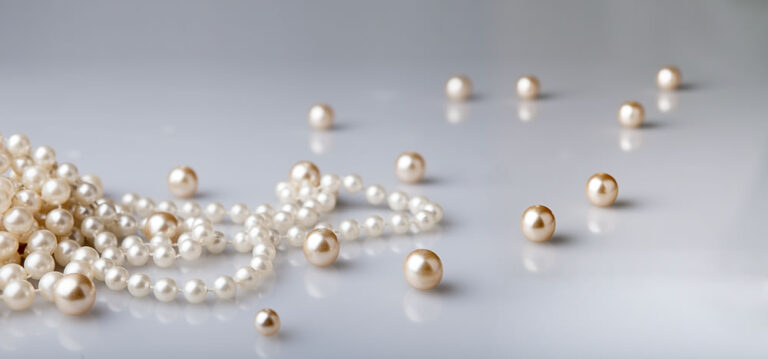
An elegant pearl necklace – every pearl’s size matters in trade beyond its carat weight. Pearls are often quoted not just by carats (like diamonds) but in a special trade unit called “chav” (also spelled chow). This isn’t a fixed mass like a gram, but a calculated weight factor that combines a pearl’s mass with its size. In simple terms, we square the pearl’s carat weight and multiply by 0.6518. For example, a 1.00 ct pearl scores 0.6518 chav, while a 3.00 ct pearl comes out to about 5.8662 chav – nine times more, not just three times. This quadratic jump gives bigger pearls a higher “weight” in chav units, reflecting the fact that large pearls often command far higher prices by size.
Traditional Pearl Weight Units
Pearl trading has a long tradition of regional weight units. In India and the Gulf, pearls were once weighed in ratti (a seed weight ~0.1215 g) or in grains, then tallied into “chow” units. One old record notes: “Pearls were weighed in RATI… then converted into CHOW… then to GRAINS. 60 chows = 36 grains.”. In practice, different ports even had their own chow size: for example, one Bahrain chow equaled 4 Basra chows and 5 Poonah (Bombay) chows. In 19th-century Bombay, a tiny unit called a buddam (also chow) was used – one buddam was just 1/1600 of a chow. (These old measures are mostly historical footnotes now.)
- Ratti and grain – Ancient gemstones used the weight of seeds (ratti) or grains. Pearls followed this system too.
- Chow definitions – Regional trades had distinct chow standards (Bahrain, Basra, Bombay).
- Buddam – Bombay’s pearl trade once used “buddam” = 1/1600 chow.
Calculating “Chav” (Step by Step)
Traders today who use “chav” follow a simple three-step formula:
- Square the carat weight. If a pearl is W carats, compute W×W.
- Multiply by 0.6518. This empirical constant converts the squared weight into chavs.
- Get the chav value. The result (W²×0.6518) is the pearl’s weight in chavs.
For example:
- 1.00 ct → 1.00²×0.6518 ≈ 0.6518 chav.
- 2.00 ct → 4.00×0.6518 ≈ 2.6072 chav (which is 4×0.6518).
- 3.00 ct → 9.00×0.6518 ≈ 5.8662 chav.
Notice the pattern: doubling the carat from 1 to 2 ct didn’t just double the chav (it became 4×); tripling to 3 ct made chav 9×. This square law means bigger pearls get a proportionally bigger chav score, highlighting their extra size beyond just raw weight.
Why Use Chav? (Mass and Size)
The chav formula gives Pearl traders a single number that accounts for both mass and apparent size. In other words, it helps standardize pricing across a range of pearl sizes. A Mahavir Gems guide explains that chand’s role is to “consider both the mass and the size of the pearl in establishing a weight factor” for trading. Practically, that means two pearls of different dimensions but the same carat weight will have different chav values if one is rounder or bigger.
- Size emphasis: Because volume grows faster than weight as diameter increases, chav highlights large pearls. A 3 ct pearl isn’t just “3 times” as valuable as a 1 ct in practice – chav treats it like 9 times (3²).
- Market consistency: Sellers often price natural saltwater pearls by the sword (chav) rather than by carat. The same trade note says natural pearls are “usually traded & expressed… in Chav or Chow”. This keeps pricing consistent for a given lot, since all pieces are converted to the same unit.
- Educational tip: While modern certified gems rarely use chav, knowing it can help buyers and hobbyists understand pearl auctions or older price lists, especially for high-value natural pearls (like those from the Persian Gulf or Bombay traditions).
In short, chav is a pearl-industry hack: it applies a bit of algebra to get a “weight” that tracks pearl size. The result is that larger pearls automatically weigh more in chav-terms, which matches the intuition that size should count in value.
Historical Context and Related Units
The name chav (or chow) itself comes from these old Indian trade measures. We saw how Indian “ratti” seeds led to chow, chow led to grains, and how Bombay once used buddam. In contrast, other pearl traditions use different systems. For instance, Japanese Akoya pearls use the momme (3.75 g) to weigh strands (but that’s a different story). What matters is that each trading culture has its own shorthand. In India/Middle-East pearl markets, chav is that shorthand.
Today, chav remains mostly in niche trade. If you’re a collector or a trader dealing in fine natural pearls, it’s a handy concept. You might see a price quote like “20 chav” rather than “XX carats” – meaning the pearls’ combined size/weight has been translated into chav units. (Remember: there’s no fixed mass like 200 mg for 1 chav; the value depends on the carats in the formula.)
Key Takeaways
- Definition: Chav (chow) is a calculated weight unit for pearls (mostly natural, saltwater pearls). It squares the carat weight and multiplies by 0.6518.
- Use: It’s used in trade to standardize pricing by reflecting a pearl’s size as well as its mass. Natural pearl sellers often quote prices per chav.
- Formula example: 3 ct pearl → 5.866 chav (so 3²×0.6518 = 5.866).
- History: Chav comes from traditional Indian pearl measures (ratti, chow, buddam). It’s an industry convention, not a gemological constant.
Conclusion
Understanding chav can make you a savvier pearl aficionado or trader. It’s not a mystical unit – just a clever math trick that traders adopted long ago. By weighting bigger pearls more heavily (via squaring the carats), chav aligns the numbers with how the market values pearl size. Next time you see a pearl price listed in chav, you’ll know it’s all about balancing mass and size to speak the language of the trade.
Sources: Industry guides and historical notes explain the chav system, confirming that one squares the carat and multiplies by 0.6518 to get the pearl’s trade weight in chavs. These sources help decode the math and history behind pearl weighing practices.
Table 1: Pearl Carat-to-Chav Conversion Chart
Formula: Chav = Carat Weight × Carat Weight × 0.6518
|
Pearl Weight (Carats)
|
Calculation |
Chav Value |
|
0.25 ct
|
0.25 × 0.25 × 0.6518 |
0.0407 |
|
0.50 ct
|
0.50 × 0.50 × 0.6518 |
0.1630 |
| 0.75 ct |
0.75 × 0.75 × 0.6518 |
0.3666
|
|
1.00 ct
|
1.00 × 1.00 × 0.6518 |
0.6518
|
| 1.50 ct |
1.50 × 1.50 × 0.6518 |
1.4666
|
|
2.00 ct
|
2.00 × 2.00 × 0.6518 |
2.6072 |
| 2.50 ct |
2.50 × 2.50 × 0.6518 |
4.0738
|
|
3.00 ct
|
3.00 × 3.00 × 0.6518 |
5.8662 |
| 4.00 ct |
4.00 × 4.00 × 0.6518 |
10.4288
|
| 5.00 ct |
5.00 × 5.00 × 0.6518 |
16.2950
|
Note: Values are rounded to four decimal places where necessary.
Table 2: Understanding How Pearl Weight Affects Chav
|
Pearl Weight
|
Square of Carat Weight |
Chav Value |
Chav Compared with a 1 ct Pearl |
|
1 ct
|
1 |
0.6518 |
1× |
| 2 ct |
4 |
2.6072 |
4×
|
|
3 ct
|
9 |
5.8662 |
9× |
|
4 ct
|
16 |
10.4288 |
16×
|
| 5 ct |
25 |
16.2950 |
25×
|

 11
Nov
 13
Oct
 13
Oct