
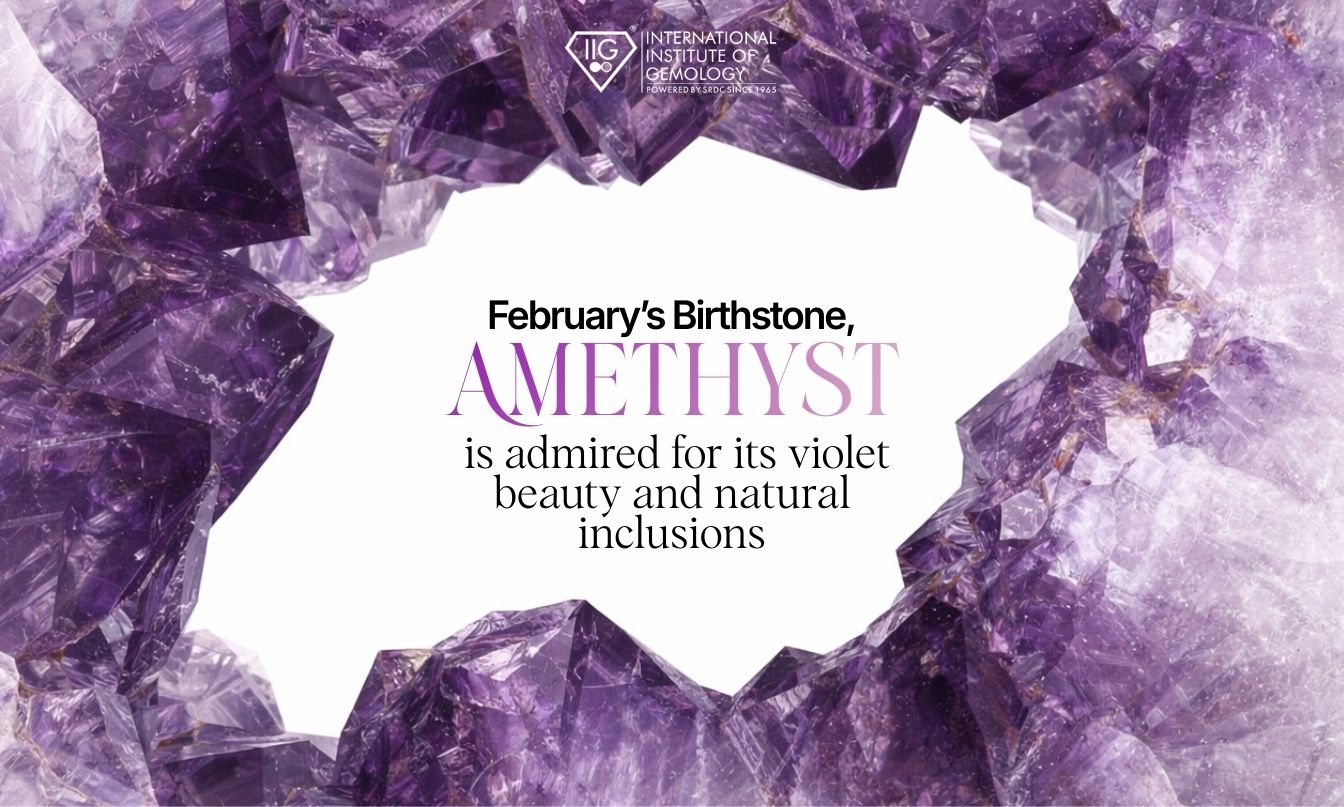
Among the many gemstones studied in gemology, amethyst holds a unique position. While widely recognised for its violet beauty and status as February’s birthstone, amethyst is far more than an ornamental stone. From an educational and geological perspective, it is one of the most important gemstones for understanding crystal growth, mineral chemistry, inclusions, and natural formation processes.
At the International Institute of Gemology (IIG), amethyst is not approached as a decorative material alone, but as a teaching stone—one that reveals how geology, time, and structure come together to create value.
Amethyst is a variety of quartz, formed when silicon dioxide crystallises in geodes and veins under specific temperature and pressure conditions. Its signature purple colour is the result of trace amounts of iron combined with natural radiation over millions of years. Even slight variations in these conditions can influence colour intensity, zoning, and clarity.

From a geological standpoint, amethyst offers an excellent example of:
These characteristics make it an essential gemstone in gemological and geological studies.
One of the most instructive aspects of amethyst lies within its inclusions. Unlike gemstones where inclusions may be difficult to observe, amethyst often displays internal features that are clearly visible under magnification and sometimes even to the naked eye.
Common inclusions studied in amethyst include:
In gemology, inclusions are critical diagnostic tools. They help professionals determine whether a stone is natural or synthetic, identify heat treatment, and assess overall authenticity. At IIG, students are trained to analyse these features methodically, learning to interpret what inclusions reveal rather than dismissing them as flaws.
Amethyst is also central to teaching treatment identification. Heat treatment, for example, can transform amethyst into citrine, altering its colour while often preserving internal features. Understanding these transformations requires:
This makes amethyst a practical reference stone in gemology courses, where learners develop the ability to detect enhancements and understand their implications in valuation and disclosure.
At the International Institute of Gemology, amethyst plays a foundational role across multiple areas of study:
Students engage with real specimens, learning to correlate theory with physical evidence. This hands-on approach builds confidence and accuracy—skills essential for gemologists, designers, retailers, and industry professionals.
Amethyst’s accessibility, combined with its geological clarity, makes it one of the most effective stones for developing observational discipline and analytical thinking.
Beyond education, amethyst remains commercially relevant across fine jewellery, fashion jewellery, and collector markets. Understanding its origin, quality factors, and treatment history enables professionals to:

In an industry increasingly focused on trust and traceability, such knowledge is no longer optional—it is expected.
Modern jewellery professionals are no longer judged solely by design or sales ability. They are expected to understand materials deeply, answer informed questions, and uphold credibility. Geological education provides this foundation.
Studying gemstones like amethyst equips learners with:
This depth of knowledge differentiates professionals in a competitive global industry.
Amethyst teaches an important lesson: true value lies beneath the surface. Its colour attracts attention, but its structure, inclusions, and formation tell the real story. For those seeking to build a serious career in gems and jewellery, learning to interpret that story is essential.
At IIG, gemology education begins with understanding stones like amethyst from the inside out—geologically, structurally, and scientifically.
Enroll now in IIG’s gemology-focused courses and begin learning the language of gemstones, written by the earth itself.
 13
Oct
 13
Oct
 02
Oct
 23
Sep





Not a member yet? Register now
Are you a member? Login now